
Designing haptic effects without writing code.
Unitouch was Actronika's software ecosystem: a haptic rendering engine, an SDK to integrate it into applications, an effect library, Unitouch Library, and a composition tool, Unitouch Studio. Its goal was to let anyone explore and integrate what HD haptics can do by thinking in sensations rather than in technical terms.
Haptic rendering engine
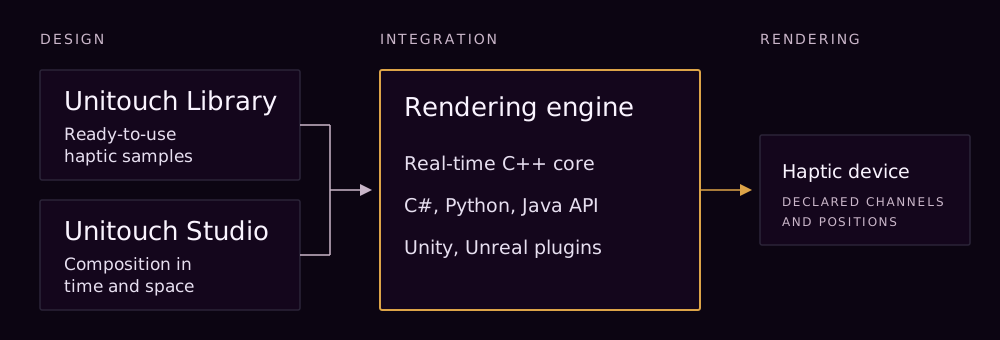
Unitouch started in 2016 with haptic interactions that tied sensing to rendering: a gesture measured by a sensor triggered a tactile response. Rendering was soon split from sensing to become an engine in its own right, real-time and procedural, embedded on Actronika's devices. Written in C++, it was then distributed as an SDK, interfaced with other languages (C#, Python and Java) and tools (Unity, Unreal and Qt), so it could be integrated into applications.
Haptic synthesis
The first effects, procedural and parametric, brought out the engine's primitives. They were organised like those of a synthesiser. An effect broke down into two layers. The signal carried the texture of the sensation through its waveform: sines, impulses, coloured noise, and so on. The envelope shaped it over time: the attack of an impact, the decay of a bounce, the random fluctuations of a rumble.
The two layers did not need the same precision. The signal was generated at a resolution comparable to audio, because a wideband actuator also radiates sound: lowering that resolution could produce audible artefacts. The envelope modulated the signal's amplitude and spectrum over the course of the effect. Slower than the waveform, it could be computed at a much lower rate, which lightened the computing load on embedded devices.
At this stage, the engine was still reserved for the engineers in charge of integration. The haptic composition tools that followed grew out of that limit.
Unitouch Library
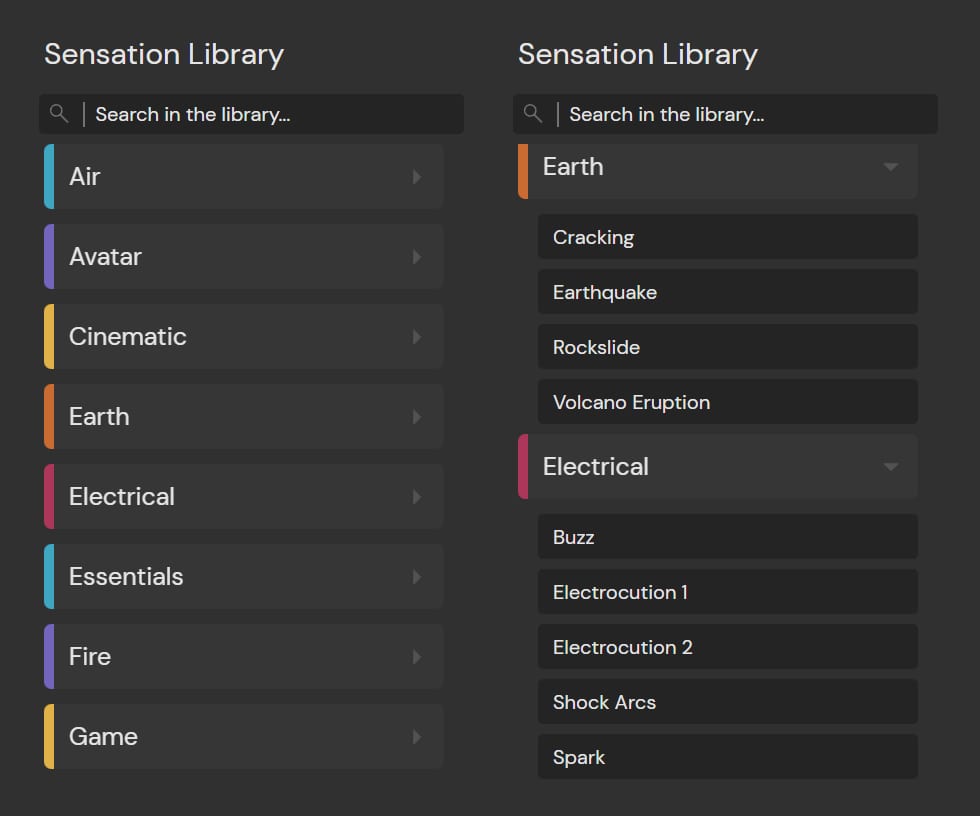
Support for audio files made it possible to build effects from samples, and no longer only through procedural synthesis. This was the origin of Unitouch Library, a collection of ready-made effects, built through Matisse Vrignaux's sound design work, to make haptics accessible to non-technical profiles.
The same sample still had to vary with the intended interaction. Unitouch made it possible to adjust its parameters at runtime, such as duration, intensity or spectrum. These settings acted directly on the perceived sensation: they could preserve an effect's character, or deliberately make it evolve. Ready-made effects thus became material to work with, rather than a catalogue of fixed sensations.
Unitouch Studio
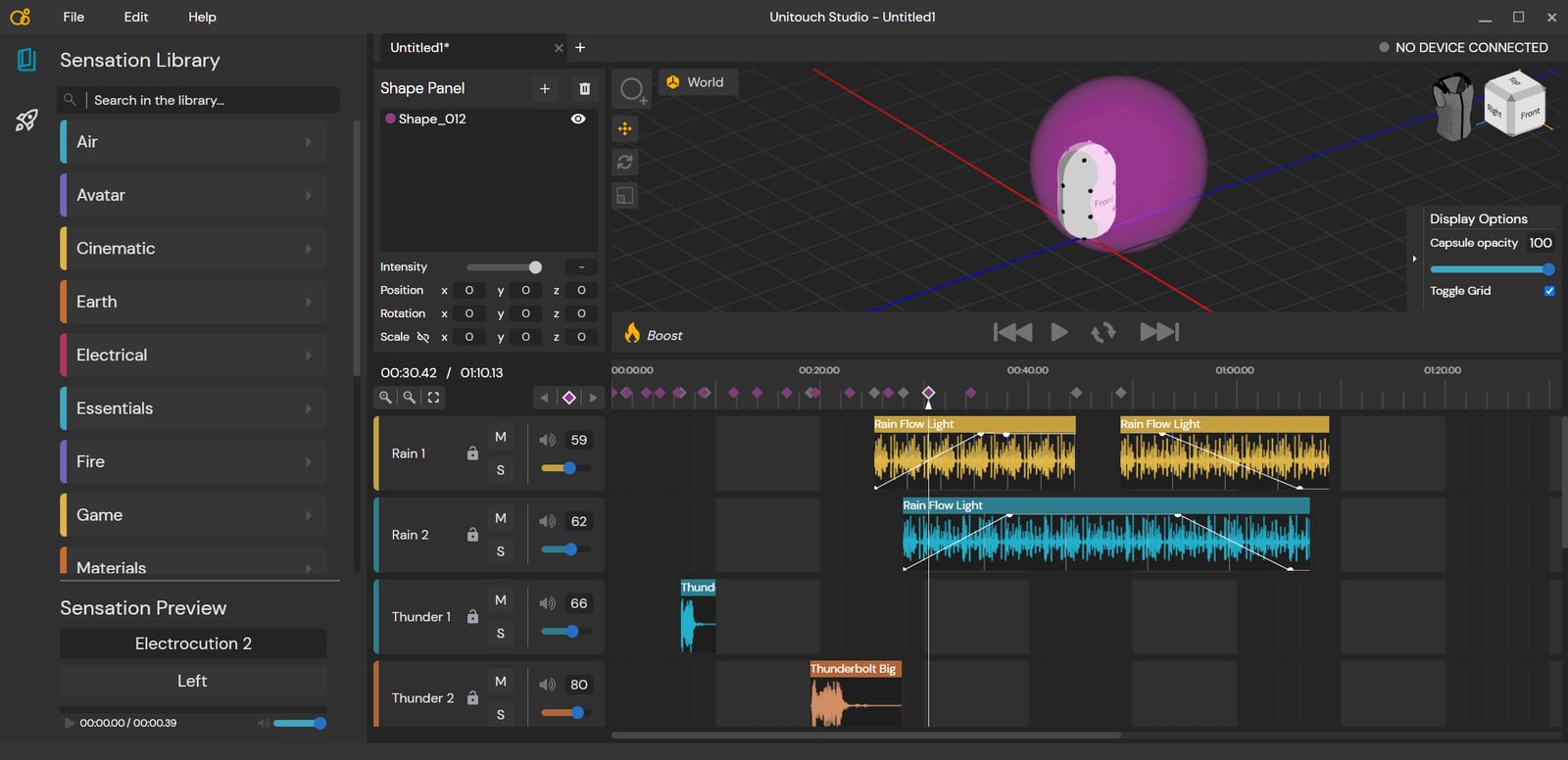
Unitouch Studio came next, to compose effects in time and in space, on a single channel or on several. User research had brought out profiles from different practices: sound, animation, development. The tool therefore borrowed conventions they already knew: a DAW timeline and animation keyframes. With Victor Mercado, PhD in design, UX and XR, the interface was designed so that spatialisation or modulation could be composed without knowing the engine, then refined based on user feedback.
Spatial composition and interoperability
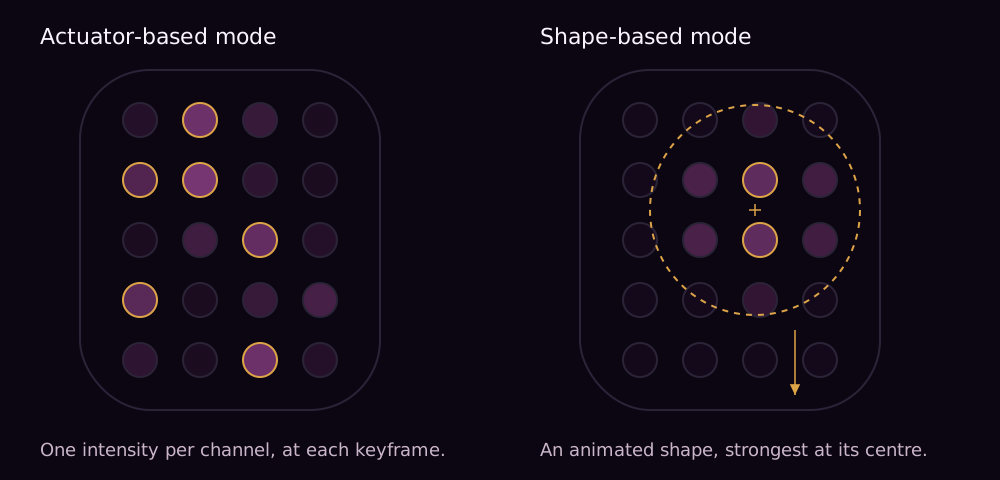
On a multichannel device such as Skinetic, an effect is composed according to its triggers and its variation over time, but also in space. The design considerations are similar to those of spatial audio. Unitouch Studio therefore offered two composition modes:
The actuator-based mode worked like a channel-based mix: each channel received its intensity at each keyframe, and the effect only made sense on the layout it was written for. On another device, two channels swapping positions was enough to distort the rendering.
The shape-based mode took an object-based approach, like immersive audio formats such as Dolby Atmos. The effect described shapes in space, animated with keyframes. Each device declared its actuators and their positions, and the engine computed the rendering at playback time. The same haptic asset could thus play on different hardware, and it was up to each device's manufacturer to handle the sensory rendering.
From Unitouch Studio to the application
An effect composed in Unitouch Studio was exported as a pattern. In the application, instances played this pattern, and their parameters could be modulated at runtime by the speed, distance or force of an interaction. The designer set the sensation; the developer tied it to the application's behaviour. The plugins ran on Windows, macOS and Linux.
Standardisation
Actronika took part in standardising haptic media within MPEG and OpenXR: signal encoding, interoperability constraints and needs across a wide range of hardware.
Role
Engineer on the early developments from 2016, then product manager on the ecosystem.
- Engineering: development of the rendering engine and of haptic interactions, explorations of procedural rendering and sound design, support for industrial clients during integration.
- Product: user research with the design team and R&D management, design of Unitouch Library and Unitouch Studio, documentation of the tools and the SDK.
- Brand: Unitouch's identity and website, built on Webflow.
- Standardisation: participation in haptic media work within MPEG and OpenXR, alongside the Haptics Industry Forum.